

Your CRM might not need a browser anymore
For twenty years, being good at Salesforce meant knowing how to navigate it. You learned the tabs. You memorized where reports lived. You figured out which list view actually showed you what you needed.
In the last few months, two announcements came out that quietly suggest the interface is optional.
Anthropic launched Claude for Nonprofits — a nonprofit-priced version of Claude with connectors into the tools nonprofits already use. Salesforce followed with Headless 360, exposing the entire platform as APIs, MCP tools, and CLI commands so agents can read and act on Salesforce without ever opening a tab.
Different companies, different audiences, same direction: your AI doesn’t have to live inside your CRM. It lives wherever you work, and the CRM becomes something it acts on.
That’s a bigger shift than it sounds. And for nonprofits, it’s worth paying attention to.
Two announcements worth paying attention to
Claude for Nonprofits
Launched late last year. Discounted Claude plans for verified 501(c)(3) organizations, MCP connectors to sector platforms like Blackbaud, Benevity, and Candid, and a free AI Fluency for Nonprofits course built with GivingTuesday. The premise is simple: meet nonprofit staff in the tools they already use, at a price structure that makes sense for their budgets.
Salesforce Headless 360
Announced at TDX last week. Over 60 new MCP tools and 30-plus preconfigured skills that give coding agents — Claude Code, Cursor, Codex, Windsurf — live access to the Salesforce platform. Agents can work with Salesforce from Slack, from a voice channel, from another app entirely. The interface is no longer the point.
Pointed at each other, these two announcements describe something new: a nonprofit could, in theory, have its staff working in Claude while the work itself lands in Salesforce. No tab-switching. No copy-paste. No “let me pull up the record real quick.”
We’re not there yet in practice. But the direction is real, and the distance between announcement and reality is closing fast.
Why this matters more for nonprofits than most people realize
Most of the coverage of Headless 360 has been written for enterprise buyers. The nonprofit angle is different, and worth naming.
Nonprofits are chronically understaffed for the software they run
A two-person operations team trying to support a 30-person staff is the norm, not the exception. An architecture that lets AI do the platform work while humans do the mission work has real appeal — probably more appeal than in most for-profit contexts. But appeal isn’t readiness, and readiness isn’t trivial.
The data inside a nonprofit CRM is more sensitive than sales data
Donor records are one thing. Program participant data, case notes, constituent histories, service records — depending on the work, this can include survivors of violence, undocumented people, minors, people in recovery. Exposing a platform to agents means exposing that data to agents. Defaults designed for sales pipelines don’t always translate.
The sector’s AI adoption curve is splitting
Some nonprofits have run real pilots. Most haven’t. The gap between those two groups just widened considerably. The risk for the second group isn’t moving slowly — it’s moving reactively, without a framework, because a funder or board member pushed them to “do something about AI.”
What fluency looks like in this new shape
In our prior post on Salesforce fluency, we argued that most nonprofits don’t have a Salesforce problem — they have a fluency problem. That’s still true. It’s just bigger now.
Fluency used to mean being able to navigate the system, read a report, and ask your admin a good question. It still means those things. It also means being able to answer four questions about any AI you let near your Salesforce org.
Where does the AI live?
Inside Salesforce (Einstein, Agentforce)? Outside Salesforce, reaching in through MCP (Claude, a coding agent, a Slack integration)? Both? The answer isn’t obvious, and it shapes everything downstream — cost, security, staff training, which vendor relationships matter, which don’t.
What is it allowed to touch?
Data it can read. Records it can modify. Actions it can take on its own. Each of those is a separate decision, and most organizations haven’t audited their sharing rules, field-level security, or permission sets in years. AI doesn’t fix that. It amplifies it.
Who’s accountable for its output?
Not who owns the tool — who owns the outcome. When the AI drafts a donor acknowledgment that goes to a major giver, when it summarizes a case note that gets quoted in a grant report, when it updates a record that shows up in the board dashboard — a person is accountable. Fluency means that person has a name, not a shrug.
What’s the rollback plan?
Every new AI-enabled workflow replaces an old workflow. Fluent organizations know how to go back if they need to. Most don’t think about this until something breaks, and by then the old muscle memory is gone.
These aren’t answers. They’re the questions a fluent leader can ask without needing to be technical. If you can’t answer them yet, that’s not a failure — it’s a signal about where to focus.
What we’re learning about Claude for Nonprofits
We’re a Salesforce consultancy, and we’ve been spending real time inside Claude — on our own work, with real data, for real use cases. Not because a client asked us to. Because it’s the most thoughtful attempt we’ve seen at an AI program built with nonprofit constraints in mind, and we wanted to understand it from the inside before we started having opinions about it.
A few things stand out:
The pricing model matches how nonprofit budgets actually work. Most AI products are priced for enterprise, and nonprofits either stretch or go without. Anthropic’s nonprofit pricing isn’t a discount — it’s a different SKU.
The MCP approach is the right approach. Instead of locking nonprofits into a new walled garden, Claude for Nonprofits connects to the platforms organizations already use. That’s the same architectural bet Headless 360 is making from the Salesforce side. Two big vendors independently landing on the same answer is a signal.
The free AI Fluency for Nonprofits course is a real investment, not a marketing artifact. It was built with GivingTuesday, it takes the sector seriously, and it doesn’t pretend AI is simple. We recommend it regardless of what CRM or AI platform you end up on.
What we can’t tell you yet, honestly, is what a Claude for Nonprofits plus Salesforce Headless 360 implementation looks like in production at a real nonprofit. Nobody can, because the ink is too fresh. What we can tell you is what questions to ask before you commit to anything.
What we’re watching (and what we’re helping clients think through)
There are a handful of questions we’re actively working through with the nonprofits we talk to. None of them have clean answers yet. All of them will matter more over the next twelve months than they do today.
Which parts of this are production-ready versus demo-ready. The gap between a keynote demo and a reliable Tuesday-morning workflow is always larger than it looks.
Where data governance gaps are hiding. Most nonprofit Salesforce orgs haven’t had a serious sharing-and-permissions audit in years. Agents amplify whatever’s in there. That’s fine if it’s clean. It’s less fine if it isn’t.
Which workflows are genuinely transformed by this architecture and which are just getting a new coat of paint. Drafting donor communications? Real transformation. Dashboards? Maybe not yet.
What year two costs look like. Year one pricing in a new category is usually not the long-term pricing. Plan for both.
Whether to start inside Salesforce or outside. Einstein and Agentforce first, or Claude reaching in first? There’s a real case for either, and the right answer depends on where your team already spends their day.
Fluency is more important than ever, and it means something new
The first post argued that fluency was about confidence — the permission to ask good questions of a system nobody had explained to you.
With AI in the picture, it’s about judgment. The confidence to say “no, this feature isn’t ready for our org yet.” The confidence to say “yes, but only with a human review step.” The confidence to say “we’re not using AI for this, because the stakes are too high and the upside isn’t worth it.”
Vendors will sell inevitability. Fluent nonprofit leaders buy selectively.
The question isn’t whether AI belongs in your Salesforce org. It’s which parts of your work deserve the speed AI offers — and which parts deserve to stay slow.
If you missed Part 1
This post is Part 2 of a short series. Part 1, Salesforce Fluency for Nonprofits, makes the case that most nonprofits don’t have a Salesforce problem — they have a fluency problem. It’s the foundation this post builds on, and a reasonable read whether or not AI is on your near-term roadmap.
If you’re figuring this out, we’d like to help
Every nonprofit we talk to right now is somewhere on this curve. Some are asking whether Claude for Nonprofits makes sense for their team. Some are asking whether Headless 360 changes their roadmap. Some are asking a more basic question: is our Salesforce setup even ready for any of this?
There aren’t universal answers. There are better and worse questions. We’ve spent a lot of time in nonprofit Salesforce orgs, and we’re spending a lot of time with what’s coming next. We don’t have all the answers yet, and honestly, nobody does.
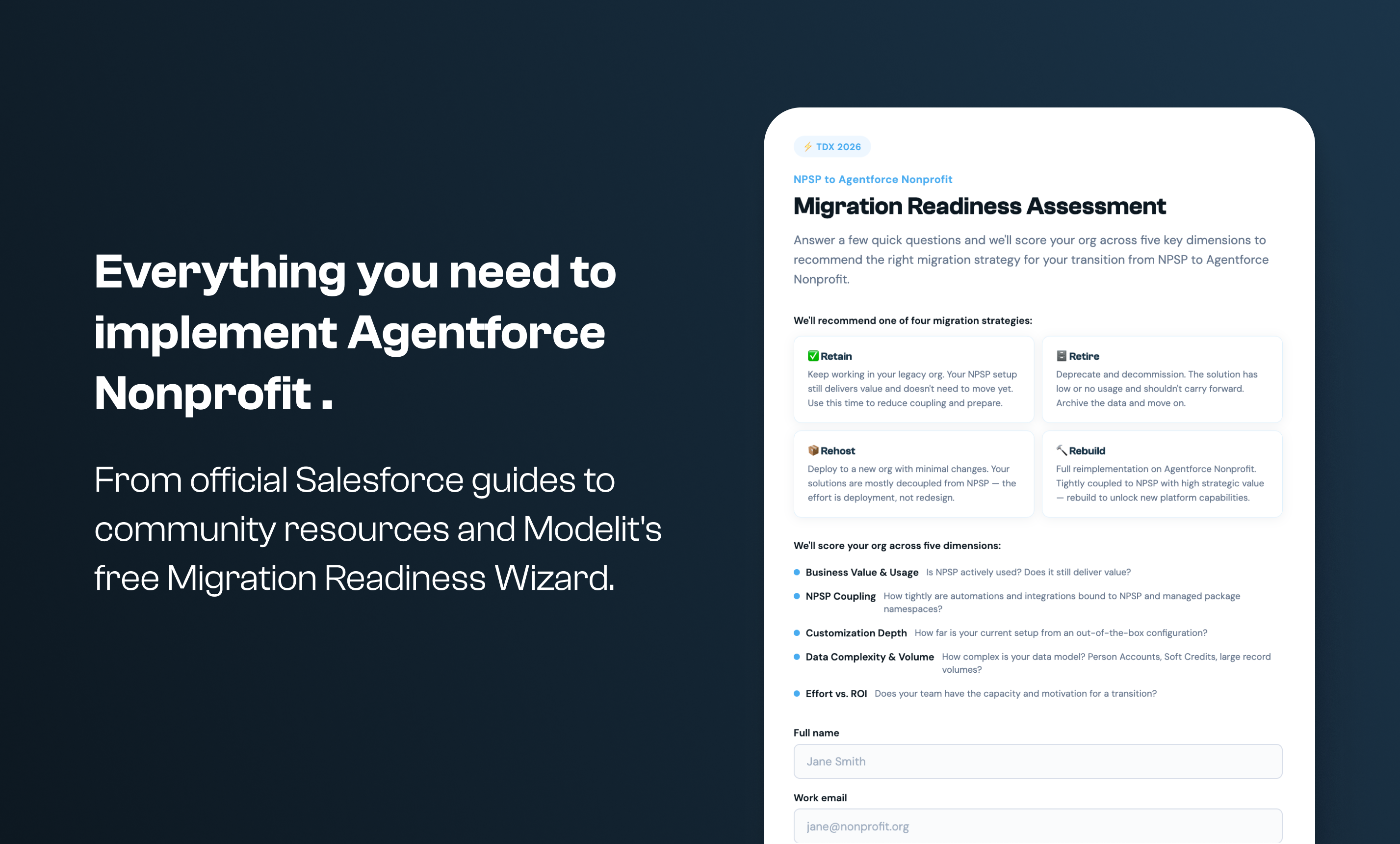
If you’re on NPSP today, the first question worth asking is whether your platform is ready for where any of this is heading. Our NPSP Migration Readiness Quiz takes about five minutes and gives you a grounded sense of where you stand. If your question is more about the shape of your current org — what’s working, what’s not, what’s quietly broken — our Salesforce Health Check is the place to start. And if you’d rather just talk it through with someone who’s spent time in both worlds, we’re around.
Summary
Two recent announcements point in the same direction: Claude for Nonprofits (Anthropic’s nonprofit AI program) and Salesforce Headless 360 (Salesforce’s platform-as-API initiative) both imply that AI doesn’t have to live inside your CRM — it can live wherever you work, with Salesforce as the system it acts on. For nonprofits, this matters more than most commentary suggests: lean ops teams have real reason to want it, constituent data has real reason to resist it, and the sector’s AI adoption curve is splitting. Fluency now means being able to answer four leadership questions about any AI near your Salesforce org: where does it live, what can it touch, who’s accountable for its output, and what’s the rollback plan. These aren’t technical questions — they’re leadership questions. We’re exploring Claude for Nonprofits ourselves, we’re watching Headless 360 closely, and we’re helping nonprofits think through what to do next. If you’re figuring yours out, we’d like to help.